K0BAK Ham Radio Van
Offered for sale is a former television station production van adapted to ham radio use featuring:
· 40-foot pneumatic mast with 150-pound capacity
· Extensive DC and AC power generation and distribution systems
· Four built-in 19” standard racks
· Ham rotator and 2x2’ platform on top of mast
· Optional radios, transverters, amplifiers, and related ham equipment
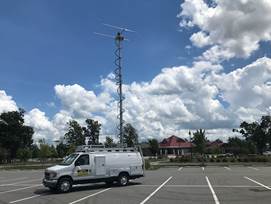
$2000 firm price for the van without most electronics; see the detailed list of included and non-included items below.
Pictures are hosted on Google Photos here:
https://photos.app.goo.gl/s8cwKiJgYx1TaDSy6
To arrange an inspection or if you have a question not
answered here,
hamvan@k0bak.com [that’s a zero not an
oh]
Base Price Description
The base price of $2000 is on the low end of the “blue book” price range of this van in “fair” condition. That price range is for the van without modification for TV production or my ham radio modifications, so it’s an incredible bargain for ham use.
The descriptions that follow disclose all issues I know about (bolded like this), but the van is offered as-is without any promise of continued operation life of the van itself or any of its subsystems.
Basic Van
· 2001 Ford E350 Super Duty Van
· 6.8L V10 automatic, uses regular gasoline
· Cruise control; air bags; air conditioning
· Double side doors, double back doors
· Passenger seat can face backwards and use temporary table
· Original AM/FM/cassette replaced with modern Pioneer AVIC-6200NEX system:
o Backup camera view automatically displayed when in reverse gear
o Bluetooth audio and AM/FM radio
o Hands-free phone calls with installed external microphone
o Navigation app with truck configuration to avoid low bridges and weight restrictions
· Van was used by a TV station in a winter road salt area:
o Extensive rust on bottom surfaces exposed to the road
o Some rusting on lower parts of sides, but not too bad for an old van
o Since late 2016, was never driven on salted roads, and was garaged in winter
· Passes annual Pennsylvania inspection, current sticker expires October 2023
TV Production Customization
· Built by Frontline, a leading customizer
· Will-Burt 40-foot pneumatic mast, model 7-42
· Built-in 120vac air compressor to power mast
· Four standard racks:
o 3 racks across mid-floor, 4th rack behind driver, all with front and back access
o External junction box on roof above 4th rack accessible from inside
o Standard AC power outlets available above or below racks, and one on main area wall
· Variable-level aimable incandescent DC spot lighting, nice while operating radio and computer
· Wide-splash DC fluorescent lighting in main and rear areas
· 120vac electric space heater built into wall below desk
· Rear external flood light
· Large AC and DC distribution panel in rear interior compartment
· Power switching and monitoring panel above permanent desk
· Permanent L-shaped desktop in front of racks 2&3 and below power panel
· Auragen 5kw 120vac generator powered from van engine (via 2nd alternator)
o This is the generator I use for powering the mast compressor
o Only available parked with engine idling; started by push button on power panel
· Generac 5kw 120vac gasoline generator using fuel from the vehicle’s gas tank
o Electric start with a momentary switch on the interior power panel
o Takes a few tries to start, last used briefly in 2020, may not start now
o The generator exhaust pipe does not have a muffler. A new one should be used.
o Manual for the generator indicates it can be wired for 240vac output (no promises)
· External connector to supply 120vac “shore power” to the van
o Non-standard twist-lock reverse socket
o I use this connection to run the mast compressor in my driveway, and to charge batteries
o Connector can accept up to 40 amps, but I only used household source (< 15 amps)
o Short adapter cable with standard male household plug is included
· Flat walkable area on roof with “diamond plate” floor
· Permanent ladder on rear door for roof access
· Platform above external air conditioning unit allows use of otherwise wasted roof area
· Tough cable bundle coil stored in basket around mast
o The cable bundle includes coax cables, twisted pairs, and multi-wire signal cables
o Designed to spiral around raised mast to carry signals to the mast top
o Coax in the bundle is rated for low frequency and power so limited use for ham radio
· Non-operable leveling jacks using DC-powered hydraulic pump; may be repairable
· Separate 120vac air conditioning; never turned on by me, assume it’s non-operable
Ham Radio Features Included in Base Price
This is some of the equipment and systems I installed to support ham radio. All of these are included in the base price of the van. If you don’t want one of these systems, for your convenience I can remove and keep any items listed here, but the base price remains the same.
· Equipment installed on the top of the pneumatic mast:
o A 2’x2’ plywood platform for securing non-rotating equipment
§ The original cable coil is supported on the bottom left side to pull it up to the top
§ An eye bolt and two-sided Type N passthrough connector for the straight cable bundle described below.
o Yaesu G-800 rotator on top of the platform
§ Bolts for the rotator pass through the platform and the top-of-mast plate
§ The platform is sandwiched between the rotator and mast mounting plate
o 1.75” OD steel rotator mast, top is almost 12 feet from the ground (my personal limit)
· A metal hose reel with a 3-cable bundle that reaches from the ground to the fully raised mast:
o LMR400 coax with N connectors; using this cable straight up to the mast top minimizes losses compared to higher-loss coax inside the native spiral cable bundle.
o Yaesu rotator control cable with their round screw-in connector on the rotator side, and their semi-proprietary 2x6 connector on the bottom side that mates with the passthrough connector on the outside mast control panel.
o A steel support cable that supports the weight of the other two cables. A loop and snap clamp is connected to the eye bolt on the bottom of the platform, allowing the cable bundle to be dragged straight up as the mast extends.
· 2” square trailer hitch receiver on both rear and front of the van
o FWIW, my intention for the front was for a tilt-up mast & rotator for microwave bands
· The outside control panel, which features the mast up-and-down buttons, has two N connector passthroughs to get RF from inside the van to the outside, and a Yaesu rotator 2x6 control connector on the outside with plain wires on the inside.
· HF screwdriver antenna support (antenna not included):
o RG-213 coax available from mid racks through floor hole in rear
o High power RF choke unun permanently installed in rear underside of van
o Jumper from choke long enough to reach a screwdriver antenna in hitch receiver
· Two 200Ah AGM (lead acid) deep discharge batteries on floor of rack #2 (middle rack of 3)
o While these can still be used, they should be considered near end-of-life and will need replacing for sustained high power radio operations
o Switching and monitoring panel in front of batteries
o Batteries are charged from inverter/charger unit on bottom of rack #1 (near doors)
· Medium current (80 amp) nominal-12v station DC system:
o Designed for an 80amp boost regulator to supply 14vdc, not included in base price
o Fused distribution rack shelf above batteries, see annotated photo
§ Four fused medium current output terminals, used for multiple VHF amplifiers
§ One 80 amp binding post output, used in the past for 500w HF amplifier
§ Solenoids can connect vehicle DC to batteries to charge while driving
§ Negative-side shunt resistor to measure station current, analog meter on rack #1
o Supports charging the vehicle batteries from 120vac shore power
§ Uses a 5-amp Battery Tender charger/maintainer, included in base price
o Switching and monitoring panel above the battery panel
· Inverter-supplied 120vac station power system
o 3kW inverter fed from the two 200Ah batteries
o AC input (for passthrough or battery charging) tied to the van’s native AC system
o Two 15-amp circuits fed to original AC outlets in racks
o A 20-amp and 30-amp outlet available on rear rack panel for kilowatt amplifiers
o Small circuit breaker box has one main 30-amp breaker, and two 15-amp breakers for the branch circuits feeding rack outlets
o While I tested the system by running two 1500-watt space heaters from the inverter, I never used the AC inverter system for radio operations so unlike the station DC system I can’t vouch for performance under contest conditions.
o Inverter wired remote control and info display mounted in rack #1
Installed Equipment for Additional Cost
The items in this section are not part of the base price; I intend to remove and reuse these if not purchased with the van. However, you can choose to buy the items and they will remain installed. Altogether you can buy a turn-key four-band competitive VHF rover that can be used in the next contest.
Be advised that I must charge full replacement cost plus compensation for complicated builds, because I want to use everything described in this section. I would be happy to figure out and quote prices for these items but only if you’re seriously interested in buying the van (please don’t ask just out of curiosity).
Each outer bullet point is a complete system that can only be purchased in the mounted set. I will not sell any of the components or systems separately from the van sale.
· Four mounted VHF+ antennas and demultiplexing relay:
o Horizontal legal-limit antennas for each band 6m, 2m, 222, 432:
§ 6m is a rigid Moxon handling legal limit; this is mounted with a goofy offset to avoid detuning when nearer the other antennas
§ The other 3 are ~10-foot Yagis from M2 Antennas: 7 el 2m, 10 el 222, 14 el 432
§ The 2m Yagi is mounted on the top position of the rotator mast
§ The 222 and 432 Yagis are mounted side-by-side on a horizontal fiberglass boom on the bottom position of the rotator mast
o Demultiplexing relay system rotating with the antennas:
§ 600-800 watt HF-through-UHF 4x1 N-connector relay in water resistant package, SSB-Electronic model AS-304
§ Relay box and a signal terminal box mounted on a Delrin rectangle, which is then mounted on rotator mast
§ 4 control signals routed to inside of van via the native cable coil
§ The idea here is to use a similar relay inside the van, so that four bands are multiplexed onto a single LMR400 coax from ground to mast top (thanks W3ICC)
· Power monitoring and band switching rack shelf
o Output of 4 per-band amplifiers goes in, gets measured, and multiplexed to one output
o WaveNode model WN-2d digital RF wattmeter, with 4 RF sensors on the rack shelf
§ Bar graph forward power and SWR for one selected band (configured scale)
§ USB output to PC for WaveNode software to display all bands’ power and more
o Same AS-304 relay as top of mast for multiplexing RF onto a single coax to the top
§ Bespoke band selection indicator lights and manual band select switch
§ Usually used in auto mode controlled by the radio via signal relays (see below)
· FlexRadio model 6500 radio, controlled with PC software via Ethernet connection
o 100w RF output for HF or 6m; 1mW (1dBm) output for transverter
o PC software connections for audio in/out, PTT, virtual COM ports via Ethernet
o Proprietary USB cables provide configurable radio state monitoring via wire
· Q5 Signal model 5BVUX 5-band VHF transverter rack shelf for 144, 222, 432, 902, 1296
o 28MHz IF, 1dBm input power, common IF and RF; 25w output powers (ex 1296)
§ Input power can be modified by owner
o Extensive bespoke build for control signals input (from Flex) and output (to amplifiers)
o 3 lower bands’ N connector RF outputs go to amplifiers on mini rack (below)
· Short rack shelf for buffering band-select signals from Flex; used to drive RF multiplexing relays
· 6m amplifier rack shelf
o M2 Antenna Systems model 6M-1K2 amplifier, no longer in production
§ Includes “JT mode” switch for higher efficiency with FT8-like modes
o Large 12vdc squirrel cage fan piped to amplifier to continuously run 400w FT8
· 50v 50Ah lithium (LiFePO4) battery, Bioenno model BLF-4850AS
o Securely mounted on the floor behind rack #1
o Includes leads from battery terminals to a large Powerpole pair
· 50vdc control and monitoring shelf
o Input from 50v battery, output to 6m amplifier
o Switch to select battery charging mode versus battery discharge mode (using amplifier)
o Switch to insert resistors temporarily to limit initial current surge to amplifier
o Analog current meter; digital voltage meter with battery-life-remaining estimate
· Mini rack of three 12vdc amplifiers from TE Systems mounted on spanning rack shelf:
o 144MHz rated 350w, 222MHz rated 225w, 432MHz rated 180w
§ Vendor’s power ratings for modes like SSB & CW; I run about half power for FT8
o PTT input signals driven by Q5 5-band transverter (see above)
o RF inputs from Q5, outputs to power monitoring rack shelf (see above)
o 2m amplifier has four high-flow fans on its heat sink, allows continuous 200w FT8
· Rack mounted Windows 10 computer
o Uses 9-15vdc for power input (instead of normal 120vac) directly from station batteries
o RF mitigations on cables inside
o Graphics card for 4k HDMI video output without taxing CPU
o Firewire card for older Flex radios like the Flex 5000, not currently used
o Bespoke external breakout of power supply’s 12v, 5v, 3.3v lines for external logic boards
· 4k UHD Samsung computer monitor mounted above desktop
o Directly powered from 14vdc station supply via Powerpole connection
· Icom IC-7100 rack shelf
o Backup radio for HF, 6m, 2m, 70cm
o Includes breakout box for 4 PTT output signals on RCA sockets
o Includes TurboTuner-2 automatic screwdriver antenna tuner
· Rotator control rack shelf
o Green Heron DC powered controller configured for Yaesu 800 rotator
o USB output for PC software rotator control; also manual dial and digital position display
o Accessible terminal strip in back for control signals
· 80amp boost regulator, supplies steady 14vdc (adjustable) as batteries’ voltage drops
o This function is not available from any current vendor, so my price will be high
o Boost regulator input and output voltage monitored with a dual digital meter
· Small RF-quiet Samlex 150-watt 120vac inverter
o Mounted on low current rack shelf (see below).
o Used to power laptops before I installed a permanent rack-mount computer
· Low current (<= 25 amps) distribution rack shelf above the medium current shelf
o Two sets of fused Powerpole outlets supplying boosted station voltage (14v)
o One fused distribution block with screw terminals supplying raw battery voltage
o Terminal strip connected to vehicle DC via dedicated native breaker